Ads in ChatGPT are matched to the conversation, not bought against a keyword list. So the natural question for any advertiser is: which conversations actually trigger them? The honest answer has two parts — there are clear patterns in what tends to trigger an ad, and there is no way to look up the list, because no such list is published.
What we know about triggering
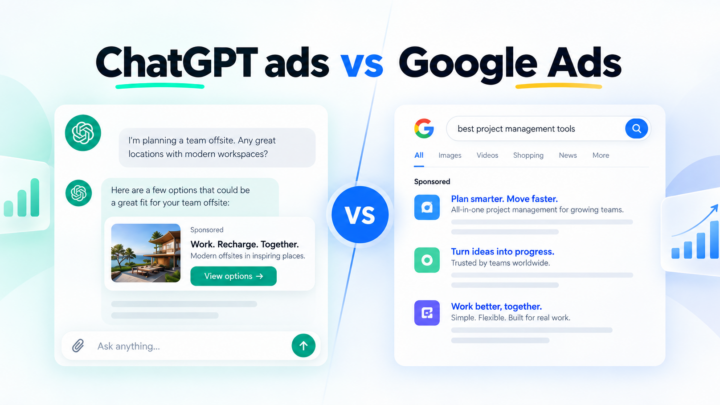
Ad delivery is contextual. OpenAI matches ads to the real-time context of a conversation, along with general location and language, and — where the user has ad personalisation switched on — past chats and prior ad interactions. Ads appear only for logged-in adult users on the Free and Go plans; paid tiers are ad-free.
From that, three things follow.
Commercial intent matters more than topic. A conversation that ends in a purchase decision is far likelier to carry an ad than one that ends in an explanation. “How does travel insurance work” and “best travel insurance for a 70-year-old with a heart condition” are the same subject, but only one of them looks like a buying moment.
An advertiser has to be bidding on that context. No bid, no ad. A question can be perfectly commercial and still return nothing, simply because nobody in that category is buying against it in that market.
Market changes the answer. Coverage varies by country and category across the 40-plus live markets, so the same question can trigger an ad in the US and nothing in the UK.
Why the same question doesn’t always trigger an ad
This is the part that catches people out. Delivery is probabilistic: ask the same question twice and you will not reliably get the same ad, or any ad. There is no fixed mapping from question to advertiser.
So “does this prompt trigger an ad?” is the wrong shape of question. The answerable version is: how often does this question return an ad, and which advertisers appear when it does? That’s a rate, and a rate needs repeated observation to estimate — a single check that comes back empty tells you nothing at all.
Why Ads Manager can’t tell you
If you’re already advertising, OpenAI’s Ads Manager reports your impressions, clicks and spend in aggregate. It does not break those totals down by the conversations they came from. You can see that your ad served; you cannot see that it served on one question forty times and on another never.
That gap matters most at the edges of your targeting. The questions your customers ask every day where your ad never appears leave no trace anywhere in your reporting — absence produces no record.
How to find out for your own category
The workable method is to fix a set of questions and sample them repeatedly.
- Write the questions in customer language. Not keywords — the way someone actually types into ChatGPT. Include the buying-moment forms: comparisons, “best X for Y”, “is X worth it”, “alternatives to X”.
- Use a Free or Go account in the target market. Checking from a paid account shows you nothing, since those tiers carry no ads.
- Ask each question repeatedly, across days and times, and record every outcome — which advertiser appeared, or that none did.
- Read the results as rates, not events. “Appeared on 9 of 30 checks” is a finding. “I saw a competitor once” isn’t.
Two limits show up quickly. Volume: a usable read per question runs to dozens of checks, multiplied by every question and market you care about. And eligibility: not every account is served ads, and the criteria are opaque — if yours isn’t eligible, every empty result is unreadable, because you can’t separate “nobody advertises here” from “this account never sees ads”.
What a good answer looks like
Done properly, the output isn’t a list of triggering prompts — it’s a ranked view of your questions by how often each returns an ad, who appears on them, and which ones consistently return nothing. That last group is usually the most useful: questions your customers ask where no advertiser has shown up yet.
Metistic measures this directly. We track a fixed set of conversations per brand, sampled on a schedule on real ad-eligible accounts in each live market, recording every outcome including the empty ones — with the sample size attached to every figure, because these are estimates and should read as such.
The free tier covers 10 conversations in one market — enough to find out which of your customers’ questions carry ads, and which are still unclaimed.