Every major ad platform eventually shipped a transparency surface — Meta’s Ad Library, Google’s Ads Transparency Center. ChatGPT advertising, live in more than 40 markets as of September 2026, has nothing equivalent. There is no public list of advertisers, no auction insights, no report that names who you’re bidding against. If competitors are advertising in your category’s conversations, the only way to know is to observe it from the user’s side.
Why one look tells you almost nothing
Ad delivery in ChatGPT is probabilistic: the same question, asked twice, won’t reliably show the same ad, or any ad. A single spot-check that shows a competitor proves they appeared once. A single check that shows nothing proves nothing at all.
Repetition is what makes the picture readable. Ask the same question forty times over a month and it stabilises — one advertiser on most checks, a second occasionally, and some share of checks with no ad served. Competitor tracking on ChatGPT is sampling, not searching.
The manual method
A first look costs nothing but time:
- Log into a Free or Go account in the market you care about. Ads only appear on these plans, so a paid account shows you nothing.
- Ask the questions your customers ask — the conversational forms, not keywords. “Best project management tool for agencies”, “is [competitor] any good”, “alternatives to [category leader]”.
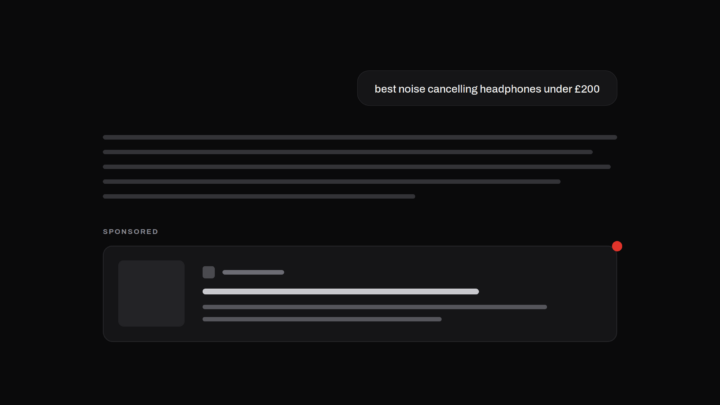
- Record what appears below each answer — advertiser, date, time. Record the empty results too.
- Repeat across days and times, keeping the question set fixed so results stay comparable.
Within a couple of weeks you’ll have a rough read on who’s active. You’ll also hit the method’s limits: the volume of checks a real sample requires, and the eligibility problem — if your account isn’t being served ads (eligibility is opaque), every empty result is unreadable, and you can’t tell an unclaimed question from a blind account.
The three numbers that matter
Whether manual or instrumented, competitor tracking on ChatGPT reduces to three measurements.
Presence rate per competitor. On each question, how often does each advertiser appear? A competitor on 70% of checks for your highest-value question is a different situation from one who surfaced once.
Share of voice. Of all ad placements observed across your category’s conversations, what share belongs to each advertiser? This is the ChatGPT equivalent of impression share — and no platform report provides it, to you or to them.
Unclaimed questions. The checks where nobody appeared. Fill rate varies widely by category: contested categories like insurance fill most conversations, while in others most checks return no advertiser at all. An unclaimed question your customers ask daily is often the most actionable finding in the whole exercise — inventory nobody in your category has contested yet.
Tracking it properly
Metistic runs this as a standing instrument: your category’s conversations, sampled repeatedly on real ad-eligible accounts in each live market, every outcome recorded including the nulls. The output is each competitor’s presence rate and share of voice, movement over time, and the map of questions where you’re absent and where everyone is. Every figure ships with its sample size, because these are estimates and should be read as such.
The free tier covers 10 conversations in one market — pick the ten questions that matter most in your category and see who’s advertising on them.