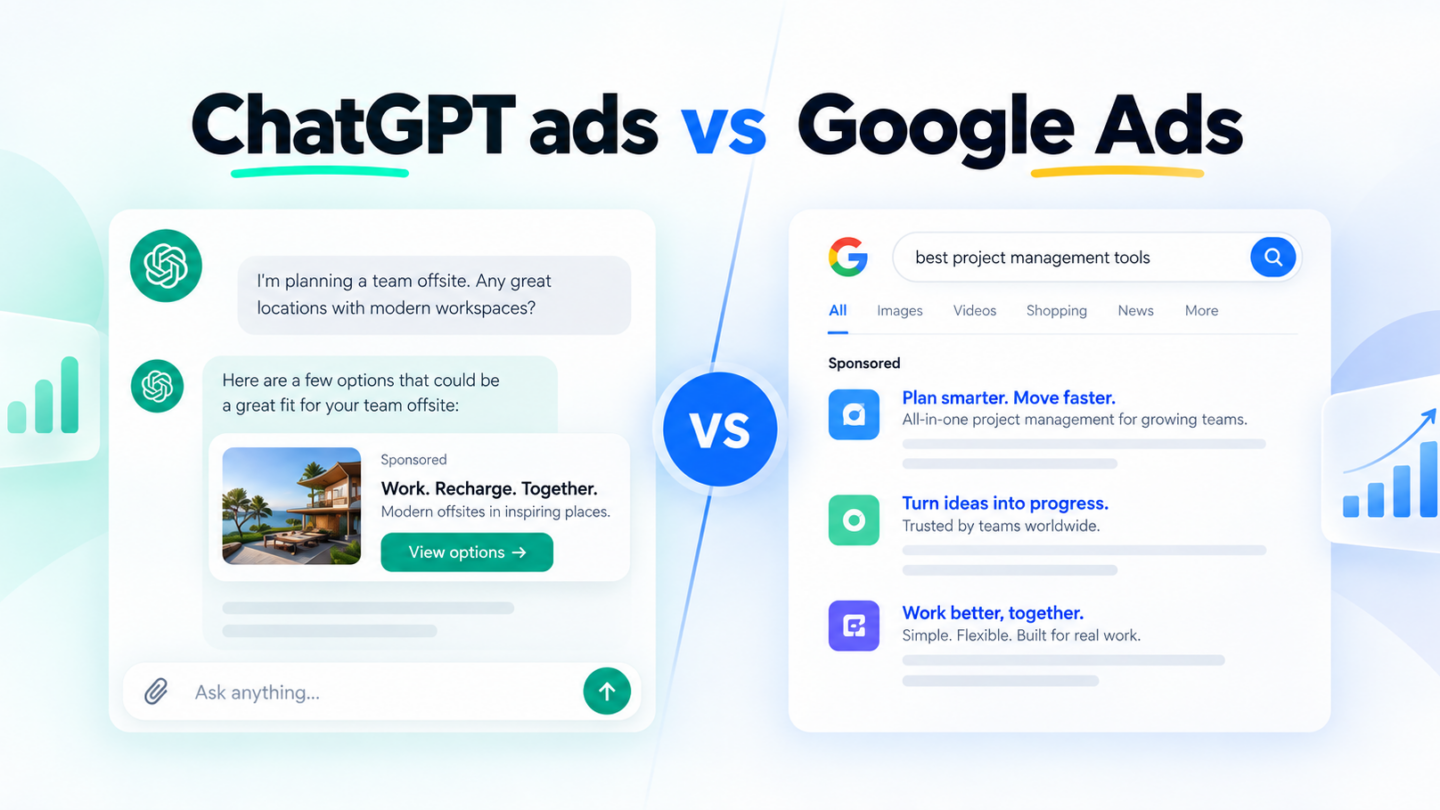
Most comparisons of the two channels are trying to answer which one you should buy. That isn’t the useful question for anyone already running paid search, because the answer is obviously both, at whatever split your budget allows.
The useful question is narrower. You have a set of habits built over years on Google: how you structure an account, how you decide a test worked, what you look at on a Monday morning. Which of those survive the move into ChatGPT, and which quietly stop working while still producing numbers that look fine?
Here’s the mechanical comparison, taken from OpenAI’s own advertiser documentation rather than from launch coverage.
The shape of the inventory
A Google search results page has slots. Several ads, ranked, above and below a list of organic results. Position is a lever, impression share is a number, and being outbid means moving down rather than disappearing.
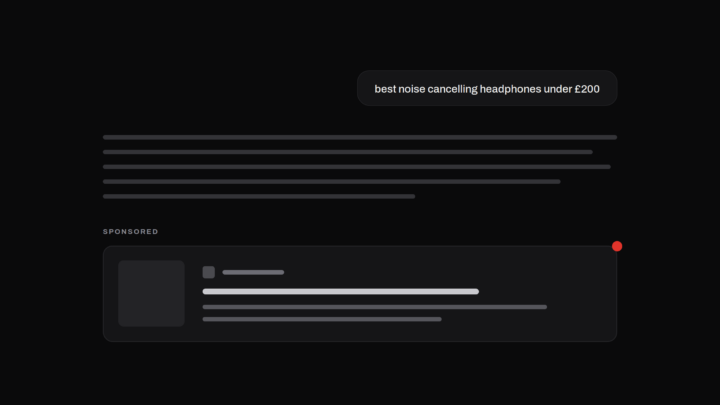
A ChatGPT response has one answer. Below it, a sponsored unit: advertiser name, favicon, headline, copy, image and landing page. That’s the whole surface. There’s no page to be at the top of, no ten blue links underneath, no second page.
Ads show to users on the Free and Go plans. Plus, Pro, Business, Enterprise and Edu accounts don’t see them at all, and neither do accounts identified as belonging to under-18s. So the reachable audience is not “people using ChatGPT” but the ad-eligible subset of them, in the markets where the channel is live. That subset moves as OpenAI opens new countries, which it has done in stages since the February 2026 pilot.
Matching: keywords versus context hints
This is the change that breaks the most Google habits.
Google Ads is built on a keyword and a match type. You bid on a phrase, you see the search terms that phrase actually caught, and you add negatives when it catches the wrong ones. That loop, keyword to search term to negative, is most of the day-to-day work of running a search account.
ChatGPT has no equivalent loop. At ad-group level you provide context hints describing the conversations and topics where your product might be relevant. OpenAI is explicit that these are not exact-match keywords and don’t guarantee delivery in any particular conversation. Selection weighs the context and intent of the current conversation, your landing page, your title and copy, your hints, and, where the user has ads personalisation on, signals from their wider ChatGPT use.
Two consequences follow. Your creative is now a matching input, not only a persuasion asset: the copy you write changes which conversations you’re eligible for. And there is no search terms report to read back, so the feedback that tells you whether your hints worked doesn’t exist inside the platform.
The controls you no longer have
Available: geographic targeting, budget and schedule, objective, bid, creative.
Not available in the self-serve platform: demographic targeting, interest or affinity audiences, retargeting, customer-list matching, lookalikes, device and placement controls. Delivery is shaped by relevance signals OpenAI holds rather than by levers you set.
If your Google account leans on audience layering, a straight port of that strategy has nothing to stand on. The equivalent work in ChatGPT is done upstream, in the specificity of the copy and the hints.
The auction
Two buying options: CPM under a Reach objective, CPC under a Clicks objective. Maximum bid is set at ad-group level, and for CPC campaigns OpenAI recommends starting somewhere between $3 and $5 per click. Selection runs a relevance-weighted, second-price auction.
Relevance-weighted will be familiar from Quality Score, and it behaves in the same broad direction: a tightly matched ad at a modest bid can beat a loose one at a higher bid. What’s different is that you can’t see your own relevance component, can’t see an auction insights view, and have no impression share metric to tell you how much of the available inventory you missed.
Reporting is where the gap is widest
Ads Manager Beta reporting covers impressions, clicks, spend, CTR, average CPC, average CPM and conversions. Conversion measurement is set up in Ads Manager, and UTM parameters on your landing page URLs persist through the click, so your own analytics can pick the traffic up.
Set that against the Google reporting you’re used to and the missing pieces are the diagnostic ones:
| Google Ads gives you | ChatGPT Ads Manager |
|---|---|
| Search terms report | No conversation-level view |
| Impression share and lost IS | No denominator, so no share |
| Auction insights | No competitor view |
| Ads Transparency Center | No public ad library |
| Keyword and match type controls | Context hints only |
Impressions and clicks tell you what happened when you won. Nothing in that list tells you what happened when you didn’t, and in a channel with one slot per answer, losing is the more common outcome.
The absence of an ad library is the part that surprises people most. Meta has one. Google has the Ads Transparency Center. ChatGPT advertising has been live since February 2026 with nothing equivalent, so there is no first-party way to find out which advertisers are running against the questions your customers ask.
Google’s conversational surface reports more than ChatGPT’s
Worth separating from the main comparison, because “ChatGPT ads vs Google AI Mode ads” is a different question again.
Google’s conversational ad formats, announced at Google Marketing Live in May 2026 and tested through AI Mode, sit inside the account you already have. They’re bought through existing campaign types, billed through the same auction, and reported in the same interface. Google’s AI Max reporting even labels where a search term came from, including traffic matched with no keyword involved at all.
So the conversational surface isn’t inherently unmeasurable. Google is monetising one and still handing back search-term-level data. The reporting gap in ChatGPT is a product decision by OpenAI, not a property of AI conversations.
What transfers, and what doesn’t
Transfers: commercial intent still decides whether the moment is worth paying for. Landing page relevance still affects both performance and eligibility. Tight, specific copy still beats generic copy. Testing discipline still works, as long as you hold the test long enough.
Doesn’t transfer: the keyword-to-negative loop, audience layering, position and impression share as optimisation targets, and the assumption that the platform will show you the competitive picture.
One habit is worth naming on its own. On Google, checking a query yourself is a reasonable sanity check, because the SERP is roughly stable and everyone searching the same thing sees roughly the same thing. In ChatGPT it isn’t. Delivery is probabilistic, and the same question asked twice won’t reliably return the same ad, or any ad. Looking once and seeing nothing is not evidence of absence. It’s one observation.
The version of that check which does hold up is a rate. Ask the same question repeatedly, across a defined window and a defined market, and count. We ran 92 checks on a headphones recommendation question and recorded an ad on 62% of them (n=92). That’s a finding. “I looked and there was nothing there” isn’t.
The practical upshot
If you’re running both channels, keep the Google reporting for Google and don’t expect the ChatGPT equivalent to arrive. Budget for two separate things: the platform’s account of what your spend bought, which Ads Manager gives you, and an account of where your ads appeared and who else was there, which it doesn’t.
That second half is what Metistic measures. We sample the customer questions you care about, repeatedly, from ad-eligible accounts in your market, and report how often your ad appears, which advertisers appear when it doesn’t, and which questions in your category no one is buying at all. Every rate carries the number of observations behind it.
Start free with 10 conversations in one market: metistic.com/pricing.