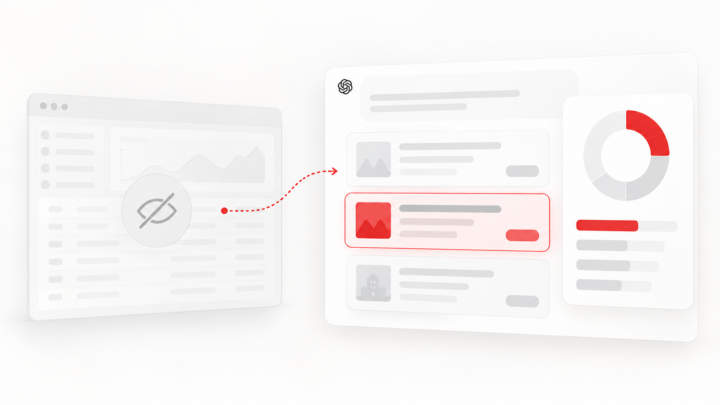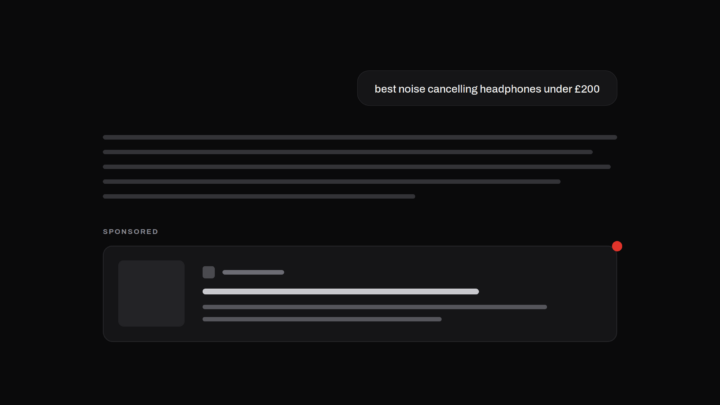
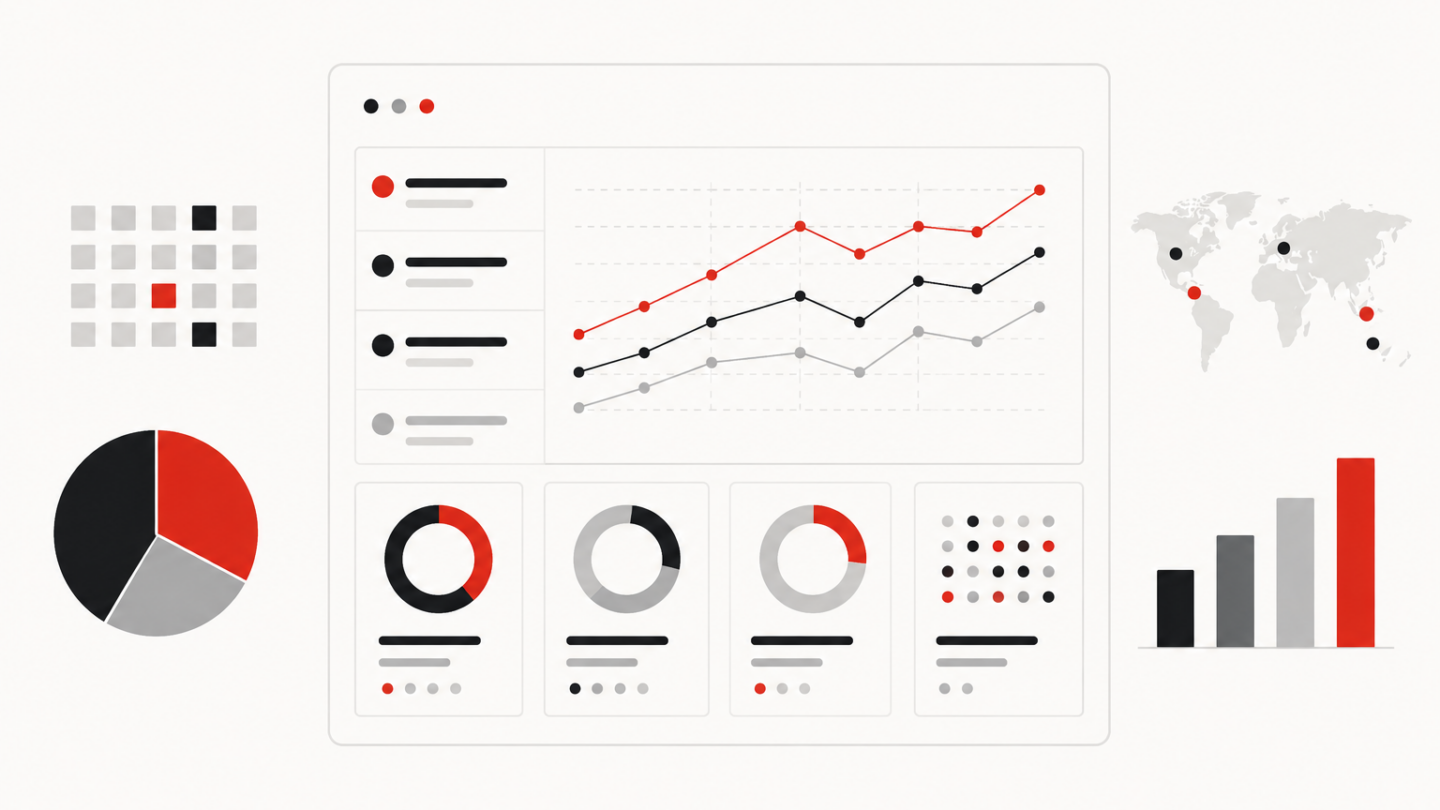
OpenAI’s Ads Manager measures your ChatGPT campaign from the platform’s side: impressions, clicks, spend. Visibility is the other side of the question — on the conversations that matter to your brand, how often do you actually appear, and against whom? The platform doesn’t report it, so it has to be measured from the user’s side. This post covers the metrics that hold up, and the methodology that decides whether they mean anything.
Why visibility needs its own measurement
Two properties of ChatGPT advertising make platform reporting insufficient on its own.
First, the reporting is totals-only. You can see that your ad served 4,000 times; you cannot see that it served on “best accounting software for freelancers” and never on “accounting software with good invoicing” — and for a contextual channel, that distribution is most of the signal.
Second, delivery is probabilistic. The same question won’t return the same ad twice, so visibility isn’t a fact you look up — it’s a rate you estimate from repeated observation. That shapes everything below.
The four metrics
Presence rate. The share of checks on a given question, in a given market and window, where your ad appeared. This is the base unit of visibility. Measured per question, because an average across questions hides exactly the distribution you’re trying to see.
Share of voice. Of all ad placements observed across your category’s conversations, the share belonging to each advertiser. It’s the ChatGPT equivalent of impression share, with one difference worth stating plainly: it’s computed against observed placements, so it describes the sample, and the sample must be big enough to describe the market.
Fill rate. The share of checks where any advertiser appeared. This varies widely by category — contested categories fill most conversations; in others most checks come back empty. Fill rate is the context that makes a share-of-voice number readable: 60% share of a category that fills 90% of the time is a different market from 60% of one that fills a quarter of the time.
Absence. The specific questions where your ad never appears — split into the ones where competitors appear instead, and the ones nobody has claimed. The second kind is often the most useful line in a visibility report.
The methodology decides whether the numbers are real
Three requirements separate a measurement from a guess.
Sample size, stated. Every rate above is an estimate from a sample, and a percentage without its n is a decoration. A presence rate from six checks has a confidence interval wide enough to be useless; one from sixty starts to mean something. Any visibility number you produce or buy should carry its sample size.
Eligible accounts, verified. Ads are shown only to logged-in adult users on Free and Go plans, and not every account is served ads — eligibility is opaque. If the observing account isn’t eligible, every empty check is unreadable: you can’t distinguish “no advertiser on this question” from “this account never sees ads”. Measurement requires verifying, continuously, that the account would be shown an ad if one existed. Without that, the nulls — which carry half the information — are noise.
Fixed questions, fixed schedule. Comparability over time requires holding the question set and the sampling schedule constant. Change either and a movement in the numbers might be the market, or might be you.
Reading a visibility report
A well-formed finding names the question, the market, the window, the rate and the sample: on “best travel insurance for over 60s”, UK, last 30 days, your ad appeared on 12 of 41 checks; one competitor appeared on 29. From there the actions write themselves — contest the question, investigate the targeting, or claim the empty ones.
Metistic measures ChatGPT ad visibility this way across live markets: real accounts, verified eligibility, fixed conversations sampled on a schedule, every figure with its n. The free tier covers 10 conversations in one market — enough to put your most important questions under measurement.